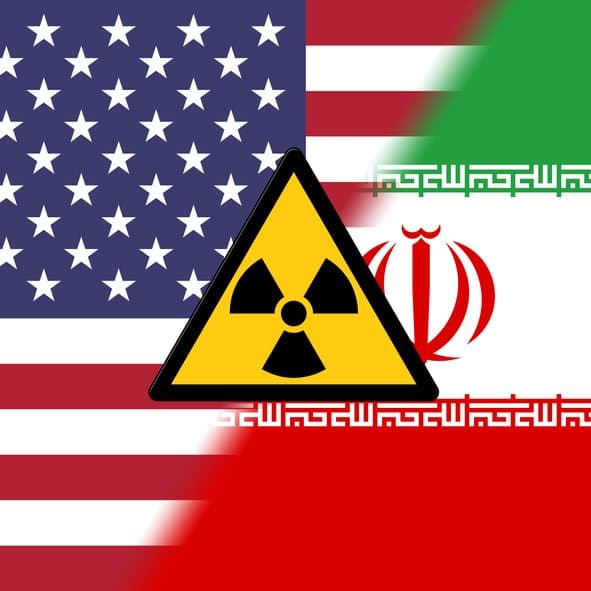
Part of: US-Iran Final Nuclear Deal by…?
US-Iran Final Nuclear Deal by August 18, 2026?
14 smart money signals detected, totaling $133,616.
Categories: Iran, Geopolitics, US-Iran, Peace Deal, Middle East, Iran Ceasefire
Notable Trades
Profitable serial macro bettor
A very large No bet on a geopolitical market from a highly active cross-market trader with substantial lifetime profits, though the edge signal is moderate rather than elite.
- This wallet has traded 104 related markets across 27 events and is up $1.64M lifetime.
- They put $57.5K on No, equal to about 60% of the market’s last-day volume.
- Entry at 81¢ suggests a high-conviction view that a final US-Iran deal will not happen by the deadline.
$75,371 on No | Wallet win rate: 64%
Profitable serial macro bettor
Profitable serial cross-market trader placed a $7.9k No bet amid an 11.8x volume spike on a geopolitically significant market.
- This bettor has a long record: 997 resolved trades, 68% wins, and about $202k in profit.
- They are a serial cross-market trader across 46 events, suggesting a repeatable event-based strategy rather than a one-off bet.
- The $7.9k No buy came during an 11.8x volume spike, adding momentum behind the same thesis.
$2,670 on No | Wallet win rate: 70%
Profitable cross-market political bettor
A profitable high-volume political bettor with a 77% long-run win rate is taking a cross-market No position on the Iran nuclear deal event.
- This bettor has won 77% of 1,193 resolved trades and is up about $70.9K lifetime.
- They are positioning across 2 related markets in the same event, suggesting a broader thesis.
- Buying No at 79¢ implies they see the final deal as unlikely despite active diplomatic headlines.
$4,950 on No | Wallet win rate: 79%
Profitable serial macro bettor
Profitable serial cross-market trader placed a $7.9k No bet amid an 11.8x volume spike on a geopolitically significant market.
- This bettor has a long record: 997 resolved trades, 68% wins, and about $202k in profit.
- They are a serial cross-market trader across 46 events, suggesting a repeatable event-based strategy rather than a one-off bet.
- The $7.9k No buy came during an 11.8x volume spike, adding momentum behind the same thesis.
$2,531 on No | Wallet win rate: 70%
Profitable cross-market political bettor
A profitable high-volume political bettor with a 77% long-run win rate is taking a cross-market No position on the Iran nuclear deal event.
- This bettor has won 77% of 1,193 resolved trades and is up about $70.9K lifetime.
- They are positioning across 2 related markets in the same event, suggesting a broader thesis.
- Buying No at 79¢ implies they see the final deal as unlikely despite active diplomatic headlines.
$4,500 on No | Wallet win rate: 79%
90% cross-market winner
Sharp 90% win-rate cross-market trader bought $5.1k of No on the US-Iran nuclear deal market, extending a proven pattern across 27 events.
- This bettor wins 90% of resolved trades and is up $31.6k lifetime.
- They are a serial cross-market trader across 27 events, with $103.8k deployed in similar event-linked positions.
- A $5.1k buy of No at 81¢ signals confidence that no final US-Iran nuclear deal lands by the deadline.
$5,103 on No | Wallet win rate: 92%
93% winner buying No
Surface despite the low composite score because this is a proven sharp wallet with a 93% resolved-bet win rate and positive lifetime P&L buying No on a geopolitical market.
- This bettor has won 26 of 28 resolved bets and is up $4,450 lifetime.
- Their record beats average entry odds by about 30 points, suggesting real edge rather than just betting favorites.
- They bought No at 81¢, aligning with the market’s current 80% view but from a wallet worth tracking.
$2,025 on No | Wallet win rate: 48%
Profitable 76% cross-market bettor
Surfaced because the wallet has a long profitable track record and is taking a cross-market No position on the US-Iran deal outcome.
- This bettor wins 76% of resolved trades and is up $22.4K lifetime.
- They are positioning across 2 related markets, suggesting a broader No thesis.
- Buying No at 80¢ means they are backing the market’s favorite side with a proven track record.
$1,750 on No | Wallet win rate: 78%
Profitable serial macro bettor
Profitable serial cross-market trader placed a $7.9k No bet amid an 11.8x volume spike on a geopolitically significant market.
- This bettor has a long record: 997 resolved trades, 68% wins, and about $202k in profit.
- They are a serial cross-market trader across 46 events, suggesting a repeatable event-based strategy rather than a one-off bet.
- The $7.9k No buy came during an 11.8x volume spike, adding momentum behind the same thesis.
$1,200 on No | Wallet win rate: 70%
Profitable serial macro bettor
Profitable serial cross-market trader placed a $7.9k No bet amid an 11.8x volume spike on a geopolitically significant market.
- This bettor has a long record: 997 resolved trades, 68% wins, and about $202k in profit.
- They are a serial cross-market trader across 46 events, suggesting a repeatable event-based strategy rather than a one-off bet.
- The $7.9k No buy came during an 11.8x volume spike, adding momentum behind the same thesis.
$1,757 on No | Wallet win rate: 70%
Top Holders
- 0xde7b...5f4b — Outcome 43309871, $385,230 (80% win rate)
- 0x7bc1...8db4 — Outcome 43309871, $111,783 (70% win rate)
- 0xfd2b...8e50 — Outcome 43309871, $100,040 (56% win rate)
- 0x9648...6825 — Outcome 43309871, $52,182 (69% win rate)
- 0xe2a9...50cb — Outcome 43309871, $43,649
- 0x78e7...2c77 — Outcome 43309871, $34,857 (100% win rate)
- 0xc658...b784 — Outcome 43309871, $25,739 (69% win rate)
- 0xdf1d...0171 — Outcome 43309871, $21,402
- 0x47e2...56c6 — Outcome 43309871, $17,813
- 0xac9b...d4c5 — Outcome 43309871, $14,177 (39% win rate)
Related Theses
US-Iran peace deal coming
Covers 9 related markets
Iran deal arrives late August
Covers 5 related markets
Iran deal in early June
Covers 9 related markets
Iran closes airspace mid-May
Covers 4 related markets
Iran ceasefire collapses by June
Covers 6 related markets
Keiko Fujimori wins presidency
Covers 2 related markets