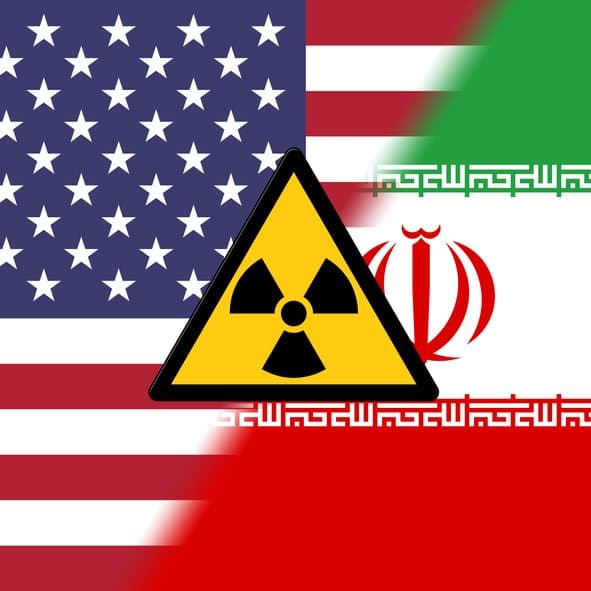
Part of: US-Iran Final Nuclear Deal by…?
US-Iran Final Nuclear Deal by September 30, 2026?
This prediction market asks whether the United States and Iran will mutually sign or adopt a qualifying written diplomatic instrument covering Iran’s nuclear program and related topics by September 30, 2026, at 11:59 PM ET. Polymarket odds can change as negotiations develop; PolySpotter currently tracks $5,487 in smart money activity across one signal, including notable No-side whale activity.
On June 14, 2026, the United States and Iran announced a written diplomatic agreement, including a 60-day extendable period in which both countries committed to negotiate toward a “final deal” regarding Iran’s nuclear program and other topics. This market resolves to “Yes” if a qualifying written diplomatic instrument between the United States and Iran has been mutually signed or adopted by the specified date, 11:59 PM ET. Otherwise, this market resolves to “No.” Unless the written instrument is formally adopted without signature as described below, the instrument must be signed by both the United States and Iran. Both parties must either sign the same document or sign individual documents that substantively and directly indicate acceptance of the same underlying instrument, regardless of minor formatting, wording, or translation differences between the signed versions. Both physical signatures and officially-issued electronic signatures will qualify as signatures. If the written instrument is recognized by the United States and Iran as not requiring signature for execution, formal adoption of the instrument by both countries without signature will qualify. Formal adoption may be established by official actions, including: (i) an official joint statement announcing that the United States and Iran have adopted, approved, executed, concluded, or otherwise finalized the instrument; (ii) mutual official confirmation that the same published instrument has been agreed to, adopted, approved, executed, or concluded by both countries; (iii) adoption, approval, or endorsement through an official resolution, ministerial decision, executive decision, or equivalent institutional act, where that act is the mechanism by which the relevant country adopts the instrument; or (iv) an exchange of official diplomatic notes or letters confirming acceptance of the same instrument. A qualifying written diplomatic instrument must: (i) Be identified as the final deal contemplated by the June 14, 2026, memorandum of understanding, either in official United States or Iranian communications, or by a consensus of credible reporting; (ii) Establish at least one specific obligation limiting Iran's nuclear program through a concrete, measurable benchmark against which compliance could be tested, which may take the form of a defined limit, prohibition, or quantity (e.g., a specific cap on the purity level to which Iran may enrich uranium, or an explicit commitment for Iran to surrender, destroy, or dilute its enriched uranium stockpile). Non-specific or vague restrictions, with no defined metric (e.g., a pledge not to pursue nuclear weapons, a commitment to maintain the status quo, or an agreement to abide IAEA monitoring or inspections requirements that do not specifically restrict Iran’s nuclear program) will not qualify. The content of the qualifying instrument must be expressed as an agreed obligation to be implemented. The following do not qualify: (i) a provision the substantive obligation of which remains explicitly subject to a future agreement, negotiation process, or mutually agreed follow-on instrument; (ii) a provision explicitly framed as a minimum requirement for a future negotiation, rather than a present obligation; (iii) a floor, placeholder, or minimum standard established explicitly for the purpose of structuring ongoing or future talks. A definite and unconditional obligation may qualify, even if technical or procedural details, including the exact implementation date, timeframe, or sequencing, remain subject to future arrangements, provided that the obligation still establishes a concrete, measurable benchmark against which compliance could be tested. Conditional obligations do not qualify. Whether an instrument qualifies will be primarily determined by its officially released text. A qualifying instrument must be signed or formally adopted by both the United States and Iran by the specified date, 11:59 PM ET. If such an instrument is signed or formally adopted by that time, but the complete text has not been released, and genuine material ambiguity remains as to whether it satisfies this market’s requirements, this market may remain open for up to 28 calendar days after the specified date pending release of the text. If the text has still not been released after 28 calendar days, official and definitive announcements from the United States or Iran, and a consensus of credible reporting, will be used to determine whether the instrument qualifies. An instrument to which parties other than the United States and Iran are also party will qualify, provided that both the United States and Iran are parties to the instrument and all other requirements are satisfied. Once a diplomatic instrument has been signed or formally adopted without signature by both the United States and Iran and confirmed to satisfy the requirements of a qualifying written diplomatic instrument, this market’s condition is met, regardless of whether the instrument later enters into force, is ratified, receives legislative or treaty consent, or is subsequently repudiated, withdrawn from, or not implemented by the United States or Iran. The primary resolution sources for this market will be official communications from the governments of the United States and Iran, or their authorized representatives. A consensus of credible reporting from major news agencies of record may also be used.
12 smart money signals detected, totaling $314,805.
Categories: Iran, Geopolitics, US-Iran, Peace Deal, Middle East, Iran Ceasefire
Notable Trades
Serial event trader scaling No
A highly active, profitable serial cross-market trader is making a sizable No bet alongside $203,000 of positioning across three markets in the same event.
- This bettor is up $1.94 million across 1,298 resolved trades, providing meaningful though not elite track-record support.
- The wallet has positioned across three markets in this event with $203,191 in total exposure, suggesting a coherent bearish thesis rather than an isolated bet.
- The $21,750 No purchase is large relative to the detected market activity, entering at 87¢ while No is priced around 86¢.
$5,487 on No | Wallet win rate: 64%
Four-wallet No conviction cluster
Four wallets deployed nearly $19.5K toward No, creating a meaningful coordinated directional signal despite the market already pricing No at 90%.
- Four wallets bought No with nearly $19,500 in total, including a single $13,593 position.
- The flow is reinforced by related positioning across two markets in the same event.
- No is already priced near 90%, so the trade offers limited upside and requires holding through a long resolution window.
$19,451 on No
Serial event trader scaling No
A highly active, profitable serial cross-market trader is making a sizable No bet alongside $203,000 of positioning across three markets in the same event.
- This bettor is up $1.94 million across 1,298 resolved trades, providing meaningful though not elite track-record support.
- The wallet has positioned across three markets in this event with $203,191 in total exposure, suggesting a coherent bearish thesis rather than an isolated bet.
- The $21,750 No purchase is large relative to the detected market activity, entering at 87¢ while No is priced around 86¢.
$21,750 on No | Wallet win rate: 64%
Profitable serial macro trader
Experienced profitable cross-market trader is effectively buying Yes amid an unusually large volume spike, though the bet is modest relative to market liquidity.
- This trader has handled 161 markets across 76 events and is up $77.8K lifetime.
- They are effectively buying Yes at 29¢ as volume spikes more than 1,700x above the historical average.
- The market is active and liquid, so the signal is more about the trader’s track record than raw bet size.
$2,200 on Yes | Wallet win rate: 64%
Profitable serial macro trader
Experienced profitable cross-market trader is effectively buying Yes amid an unusually large volume spike, though the bet is modest relative to market liquidity.
- This trader has handled 161 markets across 76 events and is up $77.8K lifetime.
- They are effectively buying Yes at 29¢ as volume spikes more than 1,700x above the historical average.
- The market is active and liquid, so the signal is more about the trader’s track record than raw bet size.
$2,150 on Yes | Wallet win rate: 64%
Profitable serial macro trader
Experienced profitable cross-market trader is effectively buying Yes amid an unusually large volume spike, though the bet is modest relative to market liquidity.
- This trader has handled 161 markets across 76 events and is up $77.8K lifetime.
- They are effectively buying Yes at 29¢ as volume spikes more than 1,700x above the historical average.
- The market is active and liquid, so the signal is more about the trader’s track record than raw bet size.
$1,320 on Yes | Wallet win rate: 64%
Profitable serial macro trader
Experienced profitable cross-market trader is effectively buying Yes amid an unusually large volume spike, though the bet is modest relative to market liquidity.
- This trader has handled 161 markets across 76 events and is up $77.8K lifetime.
- They are effectively buying Yes at 29¢ as volume spikes more than 1,700x above the historical average.
- The market is active and liquid, so the signal is more about the trader’s track record than raw bet size.
$1,166 on Yes | Wallet win rate: 64%
93% winner exits No
A very sharp wallet with a 93% resolved win rate sold No, effectively flipping exposure toward Yes, though it appears to be exiting a prior No position rather than opening a fresh bet.
- This bettor wins 93% of resolved trades and is up $22.3K lifetime.
- Selling No at 70¢ is equivalent to buying Yes around 30¢.
- This looks like an exit from a prior No position, so conviction is weaker than a fresh buy.
$1,561 on Yes | Wallet win rate: 89%
$1M-profit macro whale
Profitable high-volume cross-market trader bought $151k of No amid a major volume spike and related-event positioning.
- This bettor is up $1.0M lifetime across 990 resolved trades and has deployed $51.9M total.
- They bought $151k of No, with part of the position entered at 54¢ before it moved to 72¢.
- This is part of a broader thesis: the wallet has traded 3 related markets for $460k and is a serial cross-market bettor.
$150,805 on No | Wallet win rate: 64%
Profitable serial macro trader
Experienced profitable cross-market trader is effectively buying Yes amid an unusually large volume spike, though the bet is modest relative to market liquidity.
- This trader has handled 161 markets across 76 events and is up $77.8K lifetime.
- They are effectively buying Yes at 29¢ as volume spikes more than 1,700x above the historical average.
- The market is active and liquid, so the signal is more about the trader’s track record than raw bet size.
$2,840 on Yes | Wallet win rate: 64%
Top Holders
- 0x2e0b...8070 — No, $119,926 (88% win rate)
- 0x0c0e...434e — No, $83,413 (64% win rate)
- 0xd104...acef — No, $61,420 (89% win rate)
- 0x9648...6825 — Yes, $47,809 (70% win rate)
- 0xbd04...fbb0 — Yes, $39,393 (73% win rate)
- 0x88e2...7489 — No, $38,036 (49% win rate)
- 0x8466...4e18 — Yes, $32,820
- 0xe2a9...50cb — Yes, $30,100
- 0xcb11...0d5e — Yes, $24,046
- 0xd175...46ef — Yes, $20,981 (40% win rate)
Related Theses
Hormuz blockade lifts in June
Covers 6 related markets
US-Iran talks happen in June
Covers 5 related markets
Rubio won't win nomination
Covers 16 related markets
US gets Iranian uranium soon
Covers 2 related markets
Iran deal after May
Covers 5 related markets
Iran closes airspace by June
Covers 5 related markets
Iran deal by mid-May
Covers 9 related markets