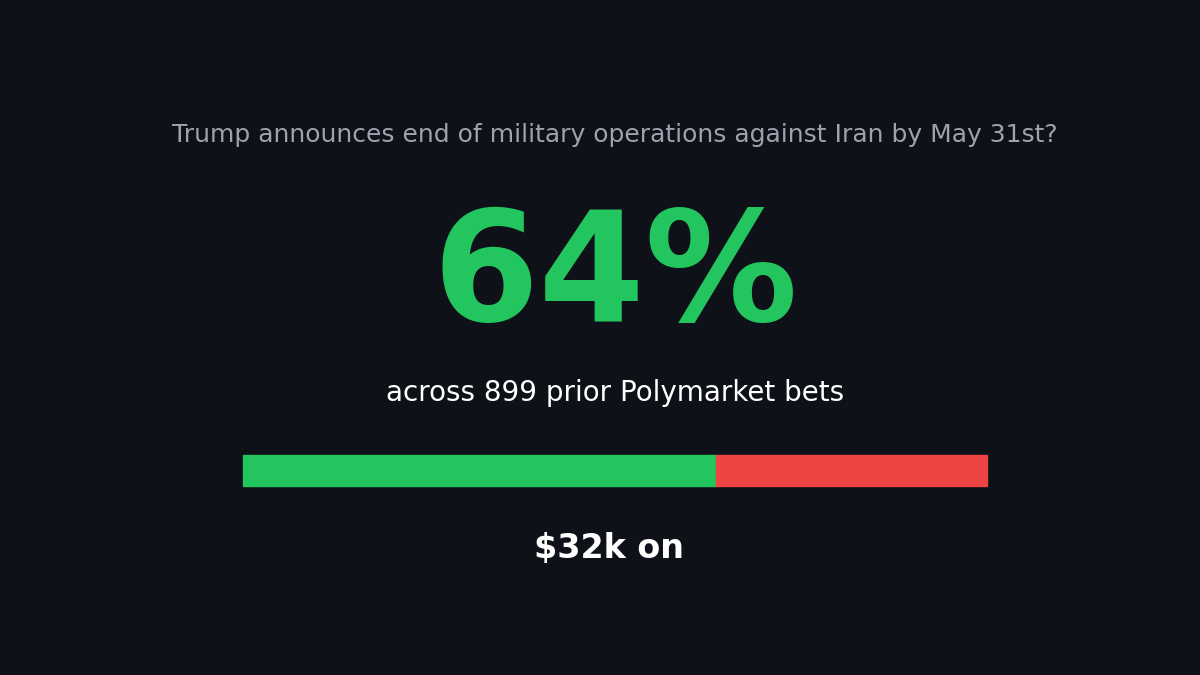
A Polymarket price reads like a probability: 26¢ is roughly a one-in-four shot. That is where one of the most profitable accounts in this market bought Yes on a very specific question: will Trump announce the end of military operations against Iran by May 31?
The answer matters because the market is not asking whether the conflict cools down in private. It is asking whether there is an announcement, by a deadline, from Trump.
The bet
The loudest trade came just after midnight UTC. An account up about $1.6M lifetime bought roughly $32k of Yes on the May 31 deadline at 26¢, taking a market that had been treating the outcome as unlikely and forcing everyone to ask whether someone knew something — or was simply early.
It was not the only Yes money. A smaller but much cleaner account, one that has won 174 of 206 closed bets and is up about $410k, bought Yes earlier at 25¢. On its face, that looks like a simple story: profitable accounts were betting that an announcement could come before the end of May.
But this market refused to stay simple.
The other side
About an hour after the $32k Yes buy, three different accounts bought No in the same May 31 market. Together they bought about $8.8k of No within roughly 10 minutes, paying from the mid-50s up into the low-60s.
That push matters because buying No at 60¢ is the mirror image of saying Yes should be around 40¢. And the buyers were not all random. One of them is up about $237k lifetime, with 890 wins against 425 losses. Another has a losing win-loss record but is still up about $285k overall, which usually means the account has made its money by being right when the dollars were largest.
Then there was the most interesting twist: the 174-32 account that had bought Yes also came back and bought No later at 55¢. That does not necessarily mean it “changed its mind.” On Polymarket, an account can own both sides at different prices and effectively trade around a volatile market. But it does make the signal harder to read than a clean Yes-versus-No fight.
What the market thinks
The market did move. In the two-hour window around the late-night trading, the May 31 Yes price rose from 24.5¢ to as high as 46.5¢ before sliding back toward the low-40s. The latest market data had May 31 Yes around 40¢, with No around 60¢.
The June 30 deadline tells a different story. That market’s Yes side sits higher, around 57¢, meaning traders see a later announcement as more likely than a May one. Two profitable cross-market accounts bought June 30 Yes in the same stretch, including one account that bought about $12.8k in two trades between 47¢ and 52.6¢.
Step back and the whole event is large. The event has done about $40.8M in total volume across its deadline markets, with a little over $1.0M in the last 24 hours. The earlier March deadlines are already closed near zero; the live debate has moved to whether an announcement lands in May or slips into June.
The track record
This is why the market is worth watching. The Yes side had the biggest single bet: the $1.6M-up account buying $32k at 26¢. The No side had a fast response from multiple accounts, including two with six-figure lifetime profits. And the June 30 Yes buying came from an account that has won 214 of 264 closed bets, up about $57k overall.
None of that proves which side is right. Prediction markets are very good at making confident people disagree in public. But when profitable accounts start trading both the May and June deadlines within minutes of each other, the price can become a useful real-time proxy for how traders interpret every official hint.
The cleanest level to watch now is 50¢ on May 31 Yes. If the market gets back above that, traders are again treating a May announcement as better than even. If it keeps fading while June holds up, the market is saying the same story may still happen — just not by the nearer deadline. You can follow the live May 31 market on PolySpotter or inspect the original $32k Yes alert.